What Does 2,650 Miles Sound Like? This Hiker Made a Sound Map of the Entire Pacific Crest Trail
Through 200 recordings made during his Pacific Crest Trail thru-hike, Tom Kelly created an interactive sound map that offers a different way to experience the trail, allowing hikers to revisit places they’ve been and inviting others to discover the trail through sound.
Story by Brad Holzwart
Photography by Tommy Corey Sponsored by Sawyer Products
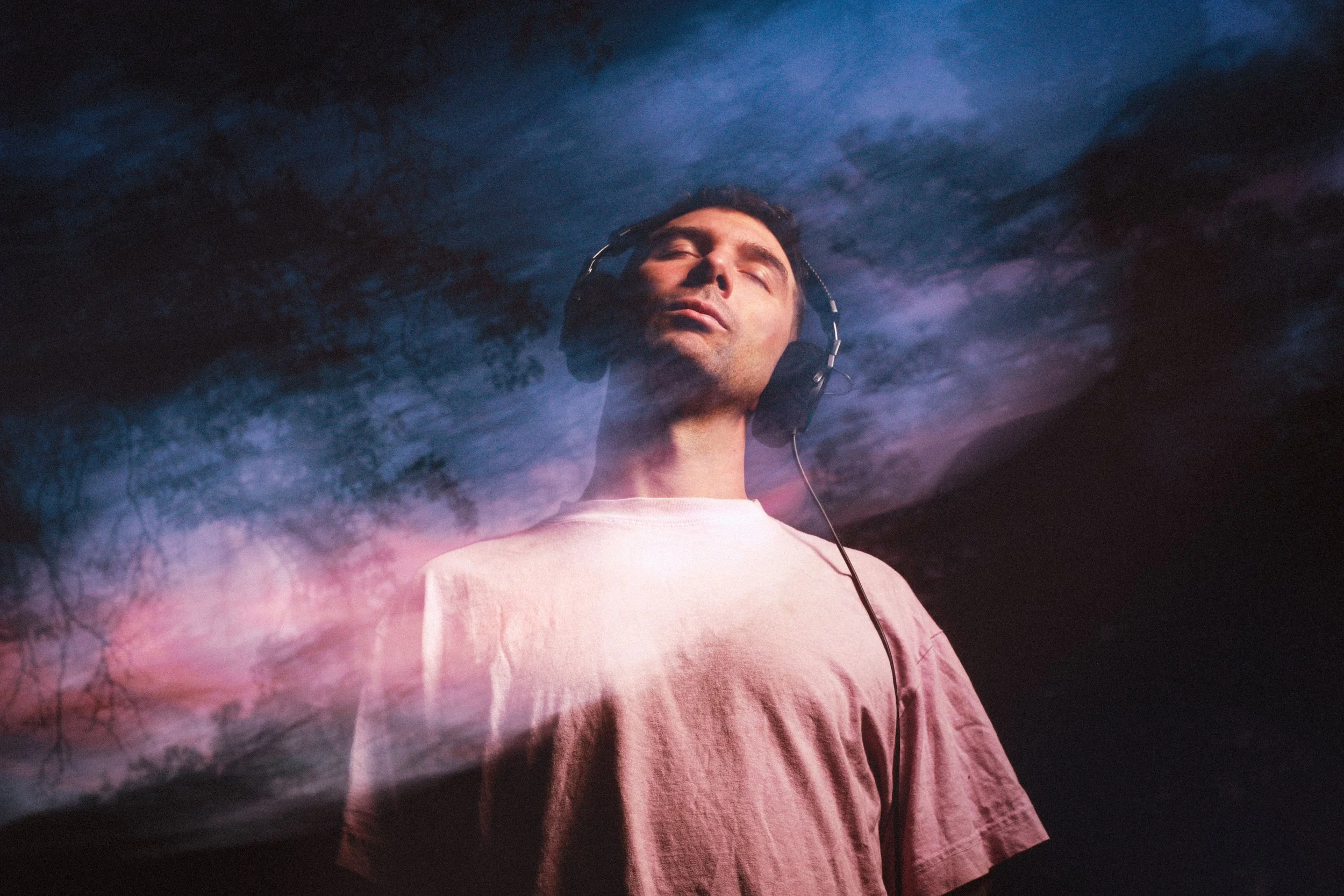
T
om Kelly sits alone on the sandy desert floor, listening. Hours ago, night spilled across the Mojave, and he set out by himself to tackle the brutal LA Aqueduct section of the Pacific Crest Trail — a desolate 40-mile stretch of concrete channels and massive pipes carrying water to Los Angeles.
He’s transfixed by a crackling of insects in the distance — a staccato electronic sizzle — that compels him to pull out his field recorder and capture the chirp of creosote katydids. In that moment, surrounded by their chorus, he understands this experience is only happening for him.
It will eventually unfold into something larger — a sound map of the entire PCT, made up of 200 recordings from Mexico to Canada, just like this one — that he can share with others.
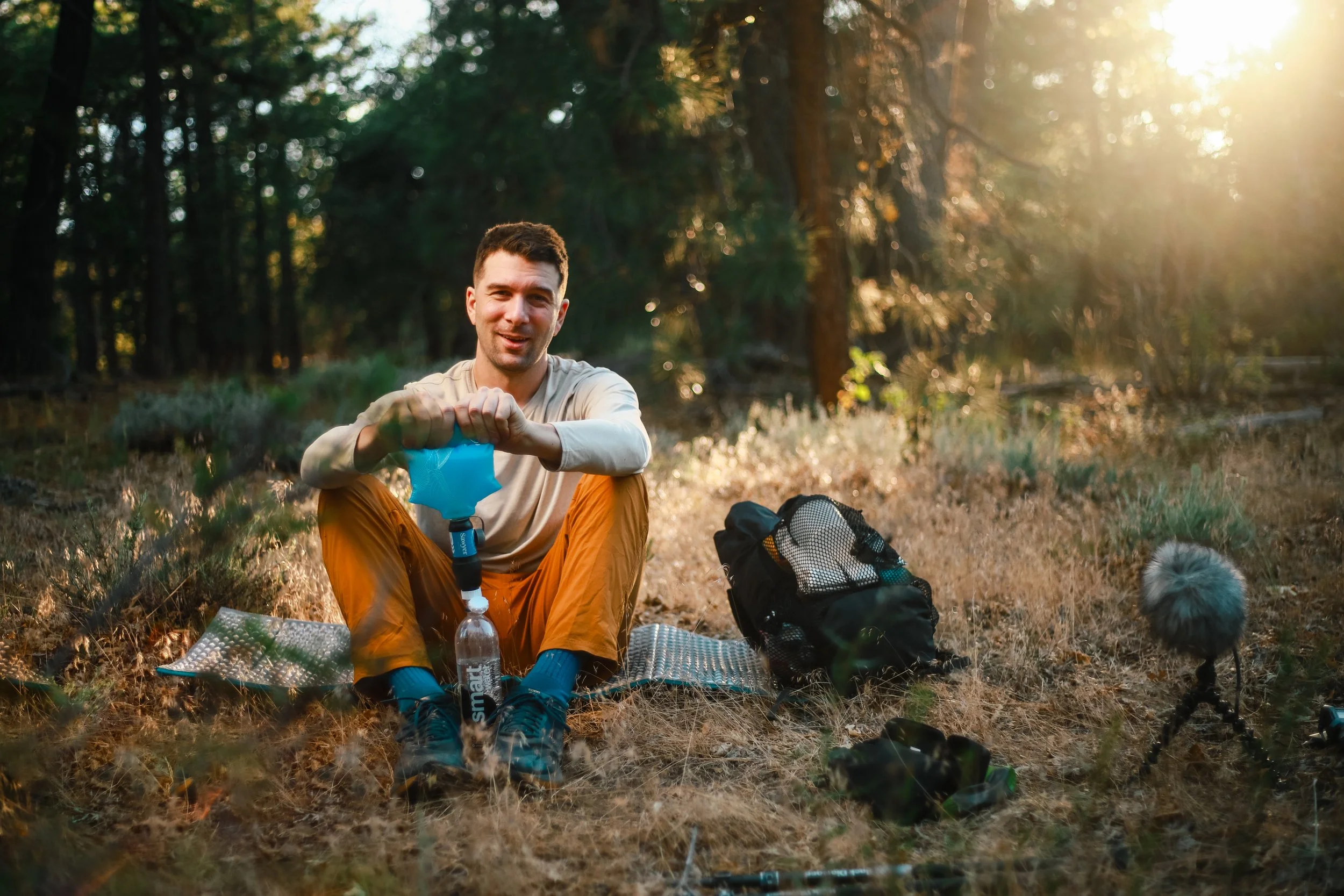
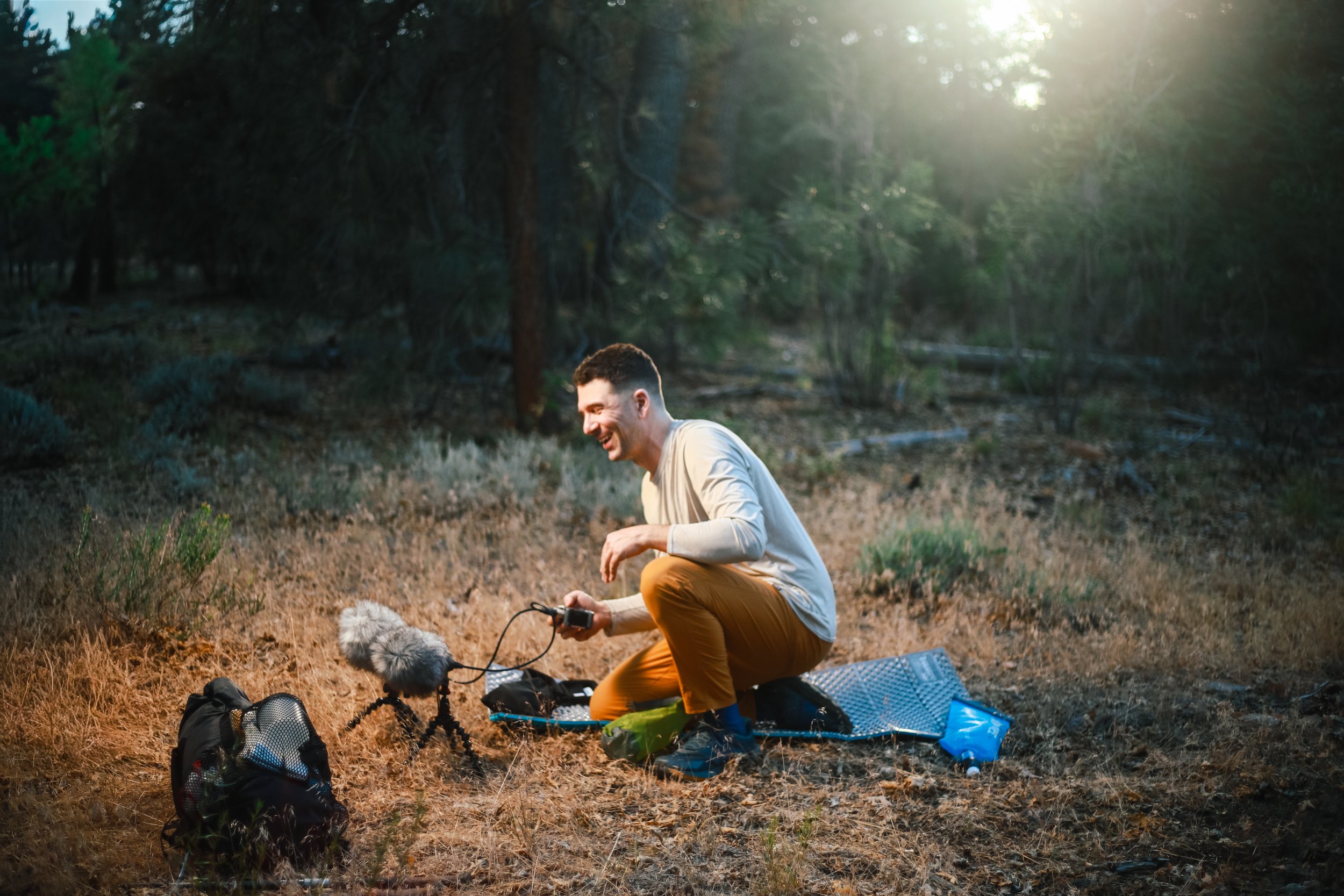
Tom can’t pinpoint where it began, but two memories resolve into focus. He is a little kid sitting in a sandbox as the day softens into evening, giving way to late summer cool, and he hears the coo of mourning doves calling to one another. In the other, he’s sitting in the grass, pressing the keys of his Tyco Hot Keyz keytar — a toy guitar/keyboard hybrid popular in the 1980s — tweaking the knobs to see how the sound changes.
Those two instincts, listening and shaping, found separate lives at first.
Listening sent him out into the world with a recorder, starting in 2013, when a trip to Istanbul had him pointing a basic Zoom recorder to capture city ambience.
“That was my way of remembering,” he says. “I created an audio journal to re-immerse myself in those places. Since then, I’ve always carried a recorder.”
Shaping found its way into composition — first on bass, then for chamber ensembles, tape machines, and modular synthesizers.
They folded back into each other when he began layering his soundscapes into musical pieces.
At 28, those instincts led him to a music composition degree at Columbia College Chicago. He was a first-generation college student.
“It was a massive challenge,” he says. “Perfectionism is ingrained in me, so I couldn’t just cruise through it.”
For five years, school demanded constant creativity on deadlines.
“I never felt like a piece was finished,” he says. “I learned in school, though, that it’s done when the deadline hits. There was a lot of self-love and self-acceptance that had to happen.”
By the time he graduated in 2018, he needed something for himself and started hiking sections of Minnesota’s Superior Hiking Trail, his field recorder an essential piece of gear.
In summer 2019, sitting in Yosemite Valley with yellow light streaming through the granite corridors, he decided he would attempt the PCT the following year. COVID delayed him and by 2021, he was too entrenched in work.
But the desire to hike the PCT never left, and Tom grew restless. In the past, he turned to yoga, bodywork, and music to reshape himself. In 2022, he attended an ayahuasca ceremony, which Tom described as a great tilling of his earth.
After the ceremony, he struggled to reintegrate into his old life, where Zoom meetings and work priorities felt hollow. He decided 2023 would be his year on the PCT.
Tom’s sister drove him to the Southern Terminus, where a crowd of hikers milled around. Panic seized him as static filled his head: why was he tossing away health insurance and job security? Then he spotted the monument, and tears poured from him. He doesn’t take out his field recorder. He just starts hiking.
“Unlike a photograph, sound is more open to interpretation. It allows people to revisit a moment.”
tom kelly

Tom is more than 700 miles into the PCT when he walks out of Kennedy Meadows, and a sheet of white noise reaches him. He knows before he sees it that he’ll stop and record the continuous roar of the Kern River. When he reaches a bridge, he pulls out his recorder, connects two microphones, and dangles them over the railing before he walks away and lounges.
This is the easy version. Usually, the moment arrives when his body isn’t ready — at the top of a pass after a long climb, when he has to settle his breath and keep his clothes from rustling. Other times, a plane flies over or hikers pass by chatting. Each disruption costs him minutes and miles.
“For this to work, I needed time by myself,” he says. “If I chose to hike with anyone, I didn’t want to slow them down with my recording.”
I ask him if there was a day he remembers being torn between making miles, staying with people, and stopping to record. He doesn’t hesitate: “Every day. I’d hear something, and the calculations would start over. How long could I give it? How far behind would it put me?”
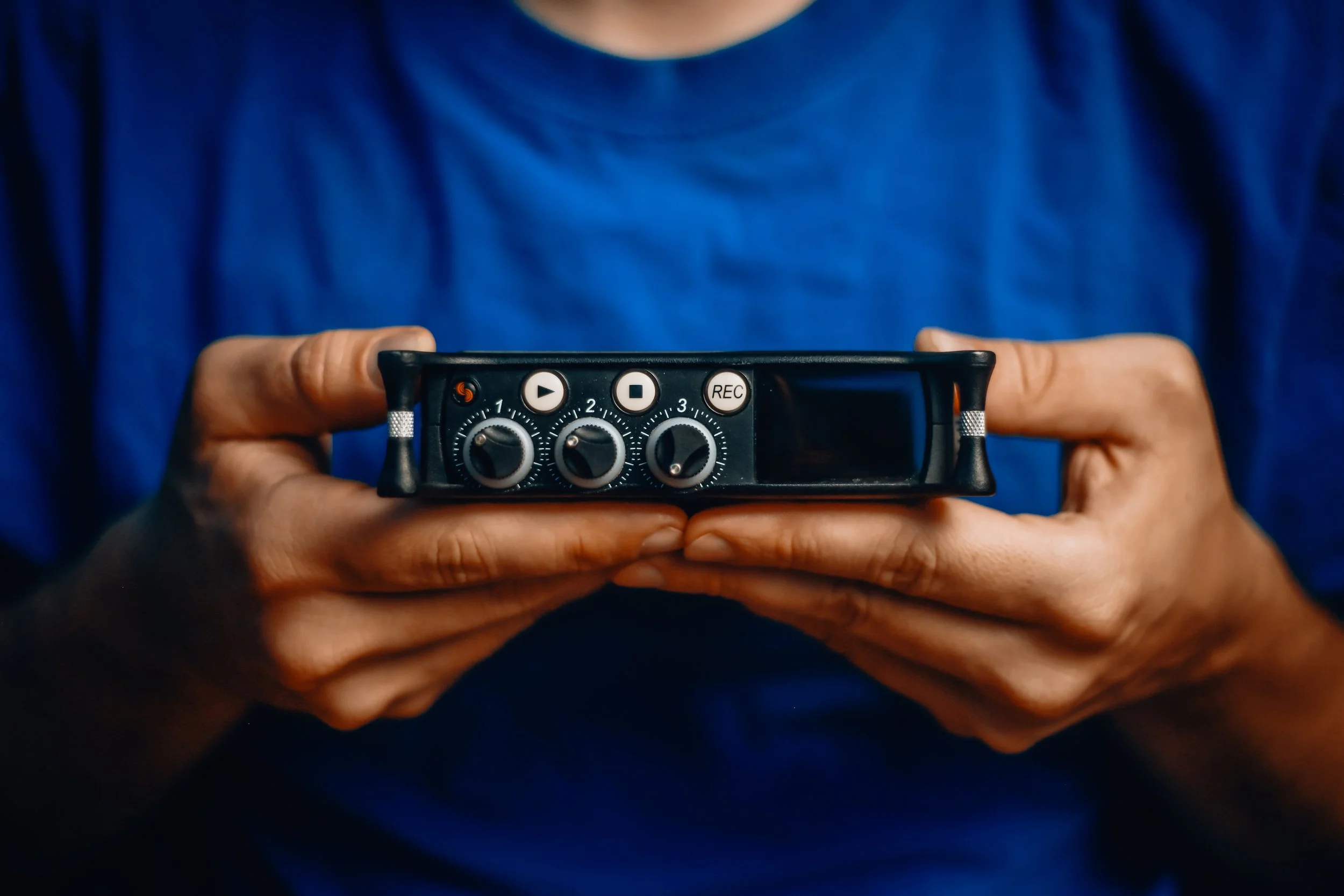
Tom also wrestled with the amount of gear he carried, trying to balance extra weight with recording capabilities. He started with a small handheld recorder and two fingertip-sized lavalier mics, then evolved to a heavier rig that he wore around his waist.
“It wasn’t awesome to carry,” he says. “But I needed quieter microphones for more delicate soundscapes and a better recorder to adjust recording levels without adding noise. I even DIY’d a windscreen out of a kid’s toy since the pro ones can cost hundreds.”
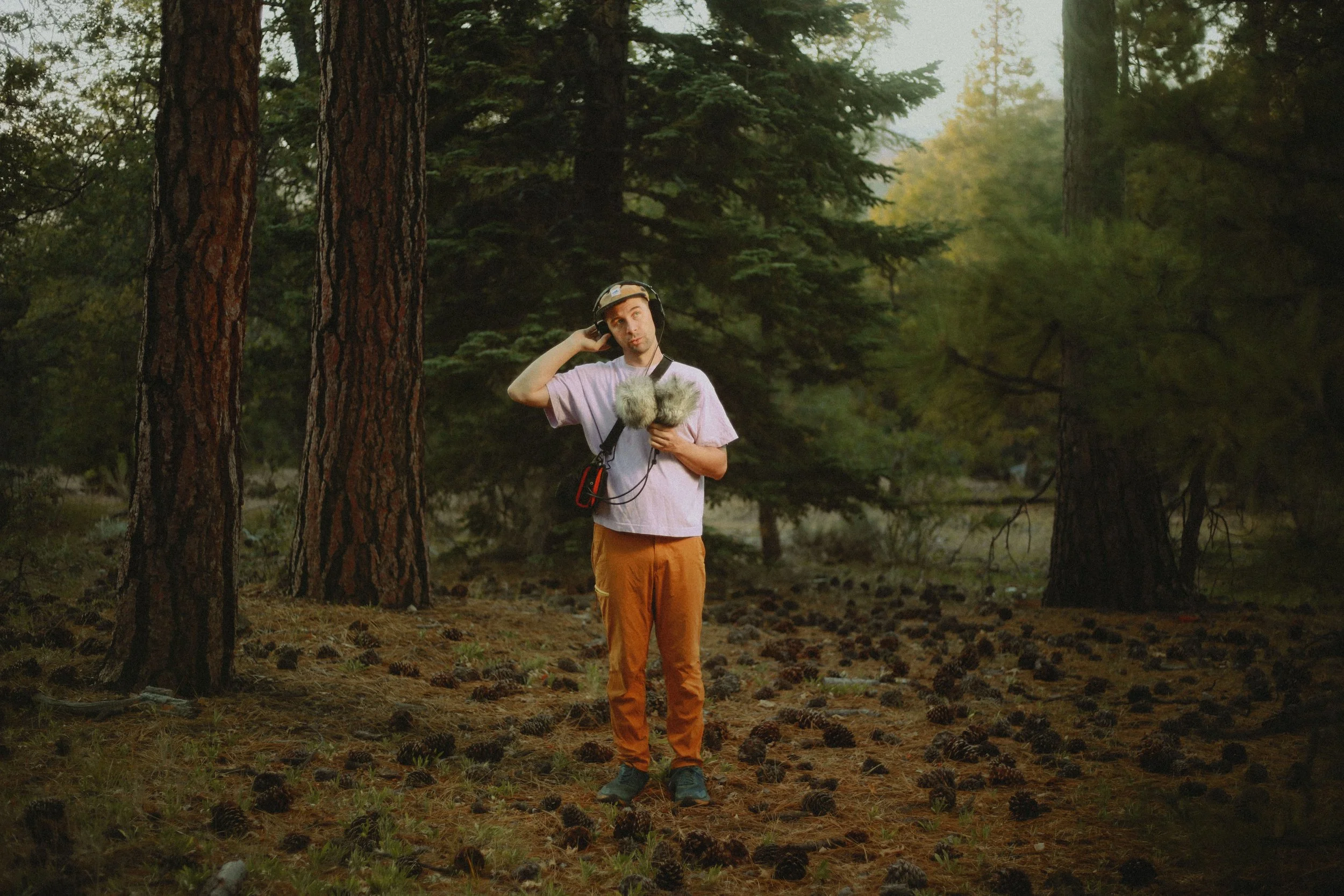
In Washington, Tom walked alongside wildflower blooms and the remnants of an old burn area, stopping to record the ring and chitter of birds — later titled “east crater regrowth ambience” — when a hiker named Mousetrap appeared.
They chatted, and he and his hiking partner, Stir, ended up walking the rest of the state with Tom, supportive of his art practice and undeterred by waiting for him.
Somewhere along the way, they started calling him Stereo, though he can’t remember which one came up with it. In every trail town that followed, Tom could see them beside him, waiting to see if he would use the name. He never did — not until he’d said goodbye to them both at the Northern Terminus.
“The name felt like this term of endearment from two very good friends that I was sharing this experience with,” Tom says.
Tom completed the PCT in Northern California after returning to make up miles he skipped to bypass the record snowpack in the Sierra. His last recording is titled “trees creaking in heavy wind 2.” It sounds like a ship moaning against the froth and churn of the ocean.
It took Tom two years to compile the sound map, meticulously editing each recording. During that time, he found a job that drew him back to the Sierra, doing bioacoustics surveys of the California Spotted Owl. It’s a fitting symmetry that he finds himself back among them when his favorite recording from trail came from an owl.
He pulls up the map, and his mouse traces the pink line from Mexico to Canada. You can sort the map by direction, random, or Stereo — the order he actually recorded in. By design, each sound has a card with only a handful of details, including the location, mile marker, and brief description. He clicks on one titled “great horned owl,” the map zooms to Northern California, and a deep resonant whoo cuts through our conversation. He clicks on “Immersive 3D” and the map drops us into a rendered version of the terrain where he recorded the sound.
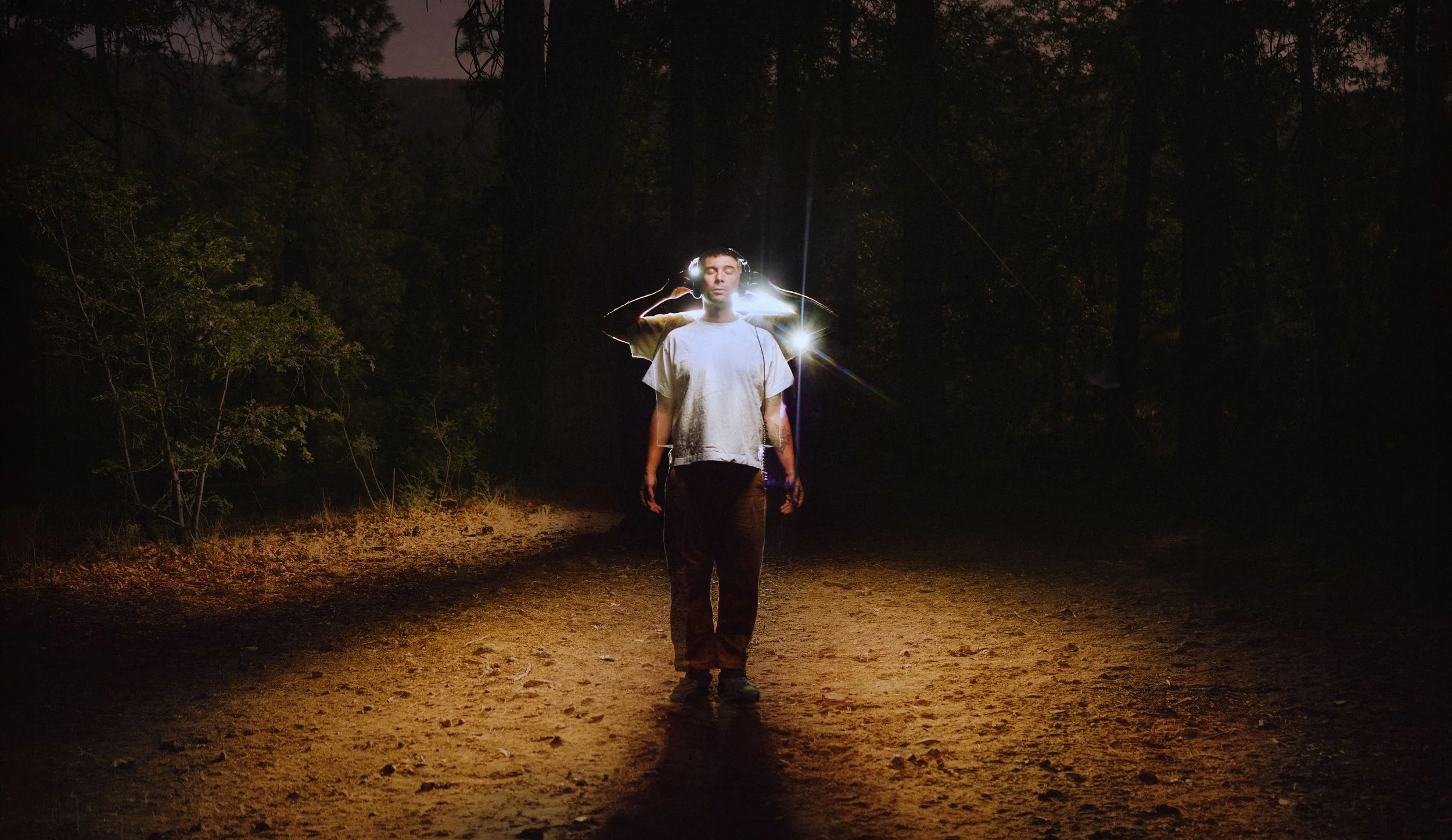
He was camped in Plumas National Forest when the owl started calling. He grabbed his kit, skipped his warm layers, and recorded for an hour, until he shook from the cold. Back in his tent, wrapped in his quilt, he heard the owl’s mate fly in, and the two of them called back and forth to each other.
“I missed the Nat Geo moment,” he says laughing, “but still had this heartbreakingly beautiful moment.”
“I recognize how much of a privilege doing a thru hike is in your life. Not everyone will be able to do it if they aren’t able-bodied or financially able to, and this is something meaningful I hope to offer.”
tom kelly
There’s no recording at either terminus either. And somewhere between Elk Lake and Timberline Lodge, nearly 150 miles of Oregon go unrecorded — a memory card he lost packing up his life to move cross country mid-hike. He’s made peace with the gap.
“Everyone experiences the map differently,” Tom says, “and that gap probably only matters to me.”
Tom doesn’t think the map has a specific audience, but this is what he pictures: a recent PCT thru-hiker still finding their footing back in the world, or someone who hiked the trail before Tom was ever born. He imagines them clicking on “desolation snowmelt,” hearing the delicate way snow drips from the trees, and, for that moment, returning to the Desolation Wilderness again.
“Unlike a photograph, sound is more open to interpretation,” Tom says. “It allows people to revisit a moment.
“I recognize how much of a privilege doing a thru hike is in your life,” he continues. “Not everyone will be able to do it if they aren’t able-bodied or financially able to, and this is something meaningful I hope to offer.”
Lisa Horix, who spent three months on the PCT in 2023, says the map does exactly what Tom envisions.
“The sound of a gushing river or small waterfall always brings my partner Philipp and me back to Washington and Oregon,” she says. “We’re still scrolling through our pictures three years later, and this will give us the actual sounds to take us back there.”
Tom gets it too. At nights, he puts his earbuds in and sets the sound map to “random” and falls asleep to the PCT. He calls it an audio weighted blanket. Sometimes the crunch of his own footsteps wakes his partner. But for a few hours each night, he’s back on trail.
Somewhere on the map, a burn scar may already be spreading across a hillside where he once recorded a “nighttime cricket chorus.” The trail will keep evolving, through fires, reroutes, decades of erosion. The recordings won’t.
On the map’s About page, Tom offers an invitation: “For all hikers, all hikers in spirit, and for anyone with a curiosity to listen more closely to the world around them…May some of what I found out there find its way to you through these recordings.”